Barbell Curl: Muscles Worked and Best Alternatives
Clear breakdown of which muscles the barbell curl trains, where it fits in a program, and 4 solid alternatives with practical guidance for equipment limits, injuries, and plateaus.
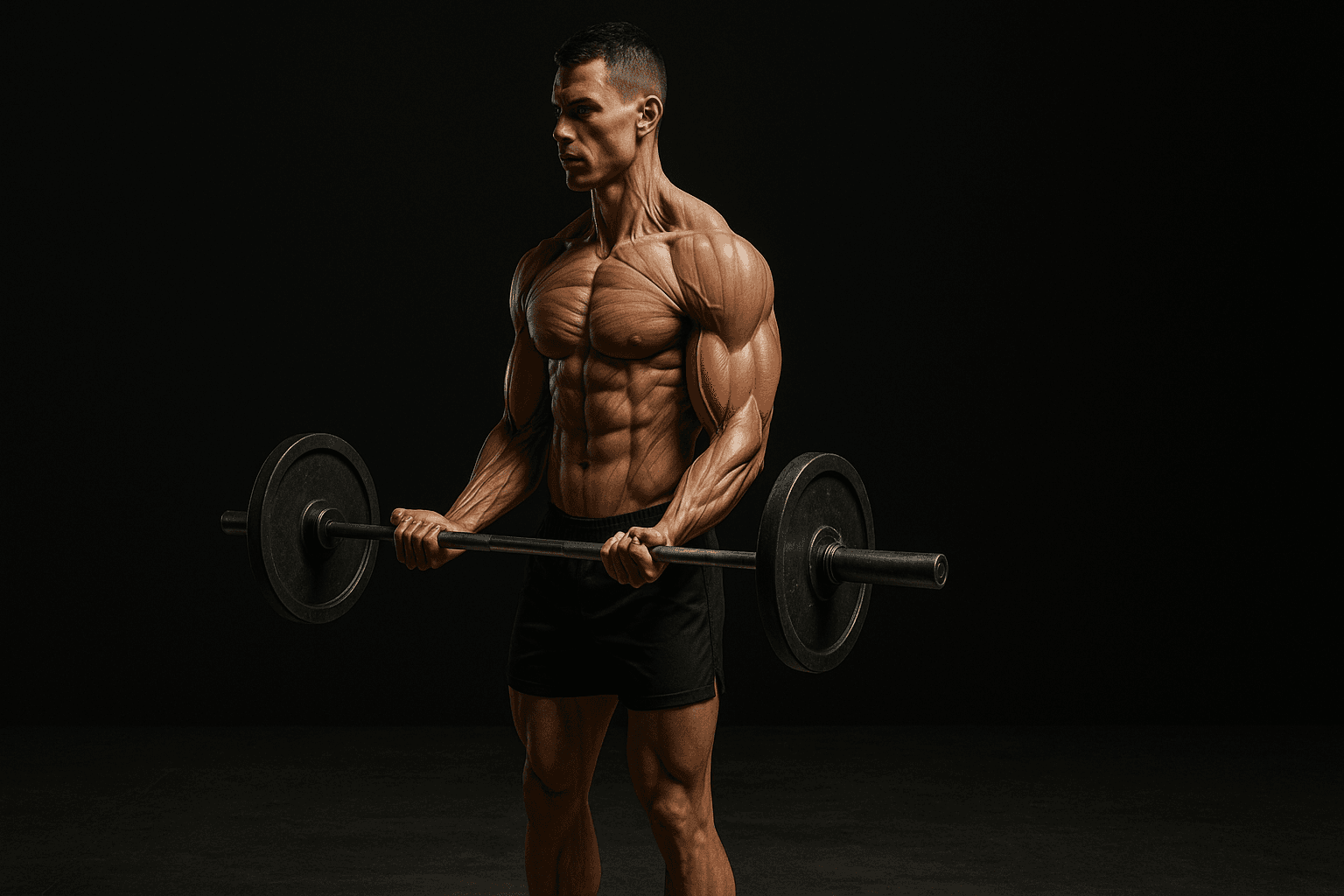
Photo by RepBro.
The barbell curl primarily trains the elbow flexors — most notably the biceps brachii — with meaningful secondary work by the brachialis, brachioradialis, and wrist/forearm flexors. It’s a direct, bilateral arm-isolation lift best used for hypertrophy and targeted arm strength.
What muscles does the barbell curl work?
Primary:
- Biceps brachii (short and long heads) — elbow flexion and some supination.
Secondary:
- Brachialis — lies under the biceps, contributes to elbow flexion (often more active with pronated grips).
- Brachioradialis — forearm muscle that helps elbow flexion, especially with neutral or hammer grips.
- Wrist flexors & stabilizers — maintain grip on the bar and resist unwanted wrist extension.
The barbell curl emphasizes the biceps because the shoulders are relatively fixed and both arms share the load, allowing heavier absolute weights than some unilateral options.
How should the barbell curl fit into a program?
- Frequency: 1–3 times per week depending on overall volume and recovery. Beginner lifters will progress with 1–2 weekly sessions; intermediate/advanced can handle 2–3 if recovery allows.
- Sets & reps: For hypertrophy, target 3–4 sets of 8–15 reps. For strength emphasis, use 3–6 sets of 4–6 reps with longer rests (2–3 minutes).
- Placement: Put it after compound upper-body work (presses, rows) or on an arm-specific day. If you need fresh biceps for pulling strength, avoid maxing them out before heavy rows or deadlifts.
- Progression: Increase load by ~2.5–5% when you can complete the top of your rep range with good form; alternate phases of heavier, lower-rep work and higher-volume hypertrophy blocks.
How to perform a safe, effective barbell curl?
- Stand shoulder-width, knees slightly bent, core braced.
- Grip the bar just inside shoulder width (standard curl grip). Wrists neutral to slightly supinated.
- Keep elbows tucked and fixed at your sides; curl the bar up by flexing the elbows, squeeze at the top for 0.5–1s.
- Lower with control to full extension without locking the elbows aggressively.
Safety note: Stop on sharp pain, especially in the elbow or wrist. If you have chronic joint issues or uncertainty about form, consult a qualified professional before continuing.
Common errors: excessive torso swing, moving the elbows forward, lifting with momentum, or using an overly wide or narrow grip that strains wrists.
What are 4 solid alternatives and when to pick each?
- Dumbbell Curl (supinated and alternating)
- Why: Unilateral work fixes left/right imbalances, allows a greater range of motion and more natural wrist rotation (you can supinate through the curl).
- When to pick it: If you have a strength imbalance, limited barbell access, or want to overload the end range. Also helpful for correcting coordination asymmetries.
- Programming notes: 3–4 sets of 8–15 reps per arm; you can use alternating reps to maintain time under tension.
- EZ-Bar Curl
- Why: The angled grip reduces wrist extension and can lower stress on the forearms and elbows compared with a straight barbell.
- When to pick it: If a straight bar causes wrist pain or if you want to lift similar heavy loads with a friendlier wrist position.
- Programming notes: Use the same set/rep ranges as barbell curls; the EZ bar often allows slightly heavier loads than dumbbells because both arms still share the load.
- Hammer Curl (dumbbell neutral grip)
- Why: Emphasizes the brachialis and brachioradialis, which contribute to thicker upper arms and stronger elbow flexion. It’s kinder to wrists because the grip is neutral.
- When to pick it: If you have wrist discomfort with supinated grips, or you want to target the brachialis to break a biceps plateau (building the underlying muscle can increase overall arm size).
- Programming notes: 3–4 sets of 6–12 reps; heavier loading works well here.
- Cable Curl (single-arm or rope)
- Why: Cables provide constant tension across the range of motion and allow variable hand positions (rope, single D-handle). They’re excellent for top-end peak contraction and controlled negatives.
- When to pick it: If you want consistent tension for strict hypertrophy, have awkward loading patterns with free weights, or need low-impact training during rehab (lighter loads, controlled range).
- Programming notes: 3–4 sets of 10–20 reps with slower eccentrics for hypertrophy; use single-arm variations to fix unilateral weaknesses.
When to favor an alternative:
- Equipment-limited gym: Dumbbells or a cable station can replace a barbell; 20–30 kg (44–66 lb) dumbbells per hand are more than enough for most lifters to progress.
- Wrist/elbow pain: Try an EZ-bar or neutral-grip hammer curls first. If pain persists, reduce load and consult a professional.
- Plateau: Use unilateral dumbbell or cable work to expose and correct side-to-side weakness; add tempo changes (3–4s eccentric) or increase weekly volume by ~10–20% to stimulate new growth.
Which variation is best for which goal?
- Pure biceps peak: Single-arm supinated dumbbell curl or cable curl for top contraction control.
- Overall arm thickness: Hammer curls to build the brachialis + heavier bar/ez-bar sets.
- Wrist-friendly heavy loading: EZ-bar curls.
- Rehab/low-load hypertrophy: Cable curls.
How to progress and avoid stalls
Rotate through variations every 4–8 weeks, alternately focusing on heavier loads (4–6 reps) and volume/tempo (8–15+ reps with slow eccentrics). If progress stalls, prioritize unilateral work, increase weekly volume by 10–20%, and check recovery (sleep, protein intake).
For tracking and plan management, consider logging sets, weights, and perceived exertion; apps like RepBro make this easier and let you compare variations or import routines—see also comparisons at https://www.repbro.app/vs if you want to weigh trade-offs between tools.
One-sentence takeaway: The barbell curl is a straightforward, effective bilateral biceps builder—use it when you want heavy, efficient biceps loading, and switch to EZ bars, dumbbells, hammers, or cables when wrists, imbalances, or plateaus demand smarter options.
Frequently asked questions
- Is the barbell curl the best exercise for biceps?
- The barbell curl is an effective, time-efficient biceps builder because it loads both arms simultaneously, but 'best' depends on goals, injury history, and equipment—dumbbells, cables, or EZ bars may be better in some cases.
- How many sets and reps should I do for biceps with barbell curls?
- For hypertrophy do 3–4 sets of 8–15 reps; for strength 3–6 sets of 4–6 reps. Keep tempo controlled and increase load or volume progressively.
- What if I get elbow or wrist pain doing barbell curls?
- Stop exercises that cause sharp pain. Try an EZ-bar, neutral-grip hammer curls, or cables for reduced wrist/elbow stress, and consult a qualified professional if pain persists.