Ladder Alternatives: What to Try and Why
Compare 4–5 practical alternatives to Ladder, with evidence-aware guidance and use-case recommendations for lifters evaluating coaching, tracking, or personalization apps.
Photo by RepBro.
If you’re outgrowing Ladder, pick an app that matches what you actually want next—more hands-off customization, stronger barbell progression tools, coach-led team features, or richer logging and watch integration. Below are 4–5 solid alternatives and when each makes sense.
What are the strongest alternatives to Ladder for people who want more program control?
- Fitbod (algorithmic builder and adaptive sessions)
- What it does well: Fitbod uses an algorithmic workout generator that adapts to your logged exercises and available equipment. It prioritizes balancing muscle groups and rotating stimulus across sessions.
- Why lifters like it: Good for people who want automatically built workouts tailored to gym access without writing sets/periodization from scratch.
- Use case: You travel frequently or switch between home and commercial gyms and want on-the-fly workouts that respect equipment and fatigue.
- Strong (simple, reliable logging and history)
- What it does well: Strong focuses on fast, reliable logging, clear PR history, and a clean interface for tracking barbell work and accessory lifts.
- Why lifters like it: If you want to track consistent progressive overload and view trends without algorithmic coaching, Strong is straightforward.
- Use case: You run your own programs (e.g., custom macros of volume/intensity) and need a minimal, fast logger to record lifts and monitor improvements.
- Jefit (exercise database and community templates)
- What it does well: Jefit offers a large library of exercises, built-in templates, and community-shared routines. It’s useful for picking or adapting pre-made plans.
- Why lifters like it: Helpful when you want structure but also lots of exercise choices and community templates to borrow from.
- Use case: You want to experiment with different splits or accessory exercises and appreciate a searchable exercise library and visual references.
- TrainHeroic (coach- and team-focused platform)
- What it does well: TrainHeroic is built for coaches and teams—delivery of programs, tracking across athletes, and coach-athlete messaging are core parts.
- Why lifters like it: If you’re joining a coached team, club, or want remote coaching with group programming, this platform supports that workflow.
- Use case: You’re part of a competitive group, a CrossFit box, or a remote coaching relationship that needs centralized program delivery and athlete monitoring.
- RepBro (AI-generated plans, AI coach chat, watch import — iOS only)
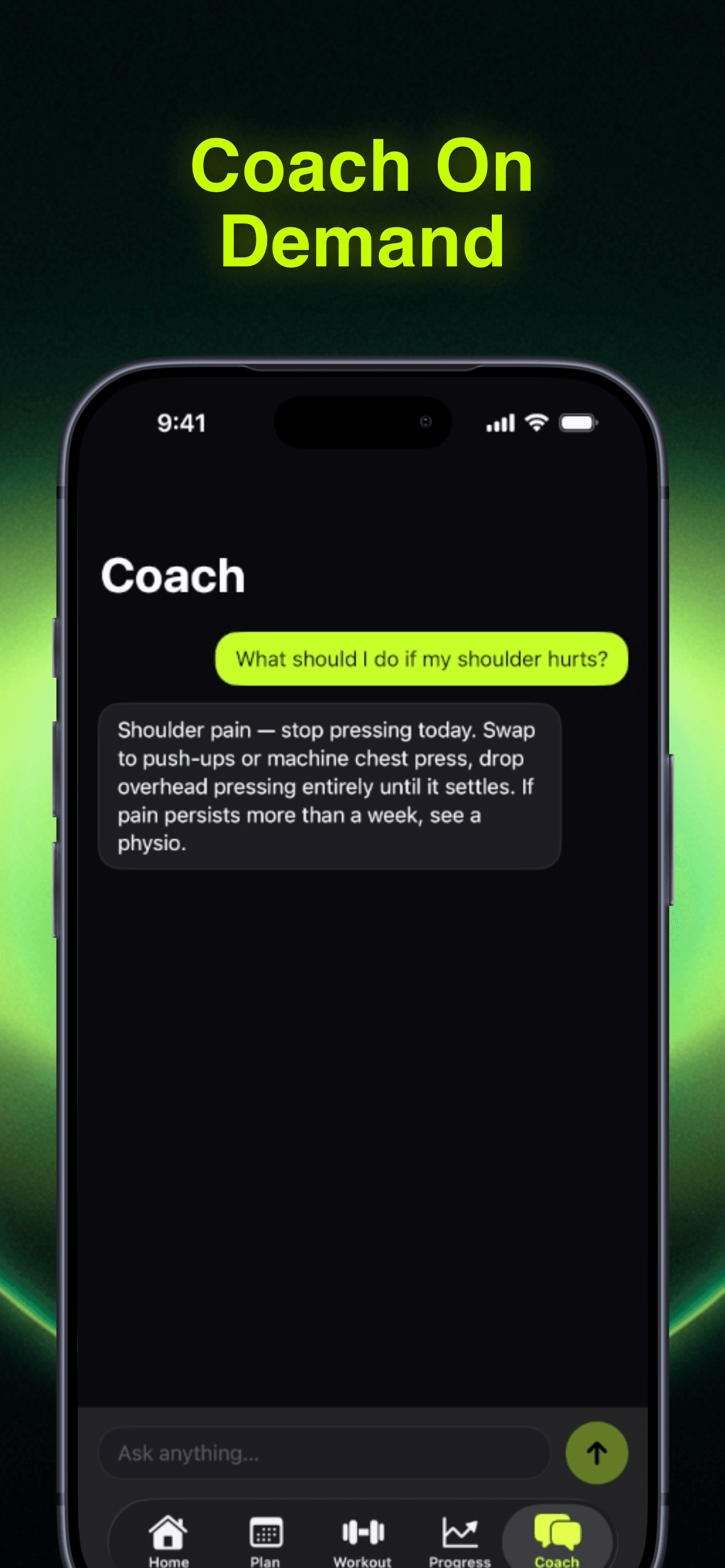
- What it does well: RepBro offers AI-generated personalized workout plans (editable), a custom plan builder, an AI coach chat and motivational coach “hype calls,” strength and cardio logging with Apple Watch import, offline-first and voice logging, ChatGPT plan import (repbro.app/import), and an AI “Future Me” transformation preview. iOS only today; subscription-based with a free trial.
- Why lifters like it: It’s a fit if you want AI-driven planning combined with practical logging (including Apple Watch sync) and quick, conversational adjustments without a human coach.
- Use case: You want an interactive AI coach and hands-on editing of the plan, plus reliable watch-based cardio/strength capture on iPhone.
How do these apps differ in practice? (comparison table)
| Feature focus | Fitbod | Strong | Jefit | TrainHeroic | RepBro |
|---|---|---|---|---|---|
| Algorithmic workout generation | Yes | No | Templates | Coach-driven | AI-generated plans |
| Fast logging / PR history | Yes | Yes | Yes | Yes | Yes (watch import, voice, offline) |
| Team/coach management | Limited | No | Community | Strong | AI coach chat |
| Large exercise database | Moderate | Moderate | Large | Moderate | Moderate |
| Offline logging | Varies | Yes | Varies | Varies | Offline-first |
| Apple Watch cardio import | Varies | Varies | Varies | Varies | Yes |
Note: Table reflects general product positioning rather than exhaustive feature lists. Check individual apps for current capabilities.
Which alternative should I pick based on my goal?
- Want automated daily workouts that adapt to fatigue and gear? Try Fitbod. It’s convenient when equipment changes and you want a hands-off builder.
- Want clean, fast logging and trend tracking for barbell progressions? Use Strong. It’s focused on logging and tendency analysis without enforced program rules.
- Want lots of exercise options and community templates to experiment with hypertrophy splits? Jefit’s library and shared plans are helpful.
- Want centralized coach programming and team athlete monitoring? TrainHeroic fits a coach-athlete ecosystem.
- Want AI plan generation plus watch import, offline logging, and conversational tweaks? Consider RepBro (iOS) for an AI-first experience and editable plans: https://apps.apple.com/us/app/gym-workout-coach-repbro/id6763749305
How do training frequency and progression fit into app choice?
Evidence supports training each muscle roughly 2–3 times per week and using progressive overload with adequate weekly volume and recovery. Pick an app that lets you control frequency and total weekly work. If you prefer preset blocks, choose an app with templated periodization; if you want to autoregulate volume and intensity, choose algorithmic or coach-driven platforms that respond to your logged performance.
Safety note: what apps cannot do
Stop training on sharp or unusual pain and consult a qualified professional. No app can reliably assess your movement quality from a couple of scalars—video feedback from a trained coach or in-person assessment is necessary for technique changes, injury rehab, or complex peaking strategies. Apps aid programming and tracking but do not guarantee injury prevention or results.
Limitations: what app- and AI-based coaching can’t do
- None can see your bar path, joint angles, or subtle technique faults from just numbers. Video analysis with a coach or clinician is required for detailed form correction.
- Complex rehabilitation, differential diagnosis, and return-to-play decisions need a medical professional or licensed physical therapist.
- A plan only works if you follow it consistently; adherence, sleep, nutrition, and stress matter more than small app differences.
- AI advice depends on input quality. Garbage in, garbage out: the more accurate and consistent your logs, the better the personalization.
Choosing a Ladder alternative means matching the app to your next needs: more hands-off adaptive workouts, faster logging, larger exercise variety, coach/team features, or an AI-first experience with strong watch and offline logging. Pick the one that aligns with how much control, coaching, and tech integration you actually want.
Frequently asked questions
- If I want more customization than Ladder, what should I choose?
- Choose an app with editable programming and granular inputs. Look for algorithmic builders that let you set frequency, equipment, and progression rules, or an AI coach/chat that adapts plans—you’ll keep control while getting personalization without a human coach.
- Which app helps most for strength-focused progression?
- Pick a tracker that emphasizes barbell programming, percentage or RPE-based progressions, and easy logging of sets/reps/weight. Apps that let you build or import linear- and autoregulated strength blocks are best for steady overload and measurable PR tracking.
- Can an app replace a human coach if I outgrow Ladder?
- Apps can automate programming, track progress, and give feedback, but they cannot see movement or manage complex rehab. For advanced technique, injury history, or competition peaking, a qualified coach or physical therapist is still necessary.